

One Drop Twenty-Three
In this great future you can't forget your past..
I was brought up in a home where the radio was always on - in my case, coming from Manchester, it was usually Radio Piccadilly 261, a local station which functioned as a proving ground for DJs who went on to greater recognition - Chris Evans, Gary Davis, Mark Radcliffe, the late Andy Peebles (and also Timmy Mallett and Andy Crane…well, nobody’s perfect). Piccadilly played a variant of what might be heard on BBC Radio 1, but looking back it taught me that radio was a great teacher of culture and style. The first reggae I heard would have been on the radio - and very probably was Bob Marley, or maybe some of the early 70’s crossover acts such as Johnny Nash or Desmond Dekker. What we heard on the radio in our childhood was partly responsible for shaping our tastes. So, thank you Piccadilly 261.
With this in mind, the latest posting celebrates one of the most enduring reggae songs No Woman, No Cry. We feature a poem from the great Geoffrey Philp in which he recalls that experience of tuning the dial of the radio until you hear something that makes you stay on that frequency. We finish with an elegy for the late Johnny Nash, whose song There Are More Questions Than Answers is one of my favourite radio-friendly hits of the early 1970s.
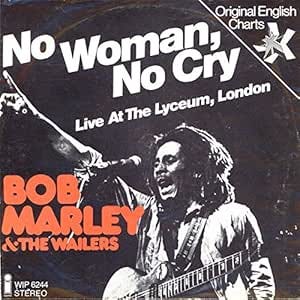
Heirlooms
Through the garbled signals
of a transistor radio
my mother kept for hurricanes like this—
but never like this—
we scan for the next location
of ice, water, food, and catch
the edge of a Caribbean-tinged
station, fragments of a Marley tune:
“No woman, nuh cry, everything’s
gonna be all right.” And my son,
barely nine months, who cut a tooth
while Andrew gnawed through the Grove,
dances with his mother—
by the glow of a kerosene lamp,
preserved through airport terminals
and garage sales, that flickered
on the mantle of the fireplace we never used.
In the midst of the rubble,
these—our only heirlooms—bind us
against the darkness outside:
all that she could ever give,
all that we could ever pass on
or possess—this light, this music.
Geoffrey Philp
Bob Marley and the Wailers perform No Woman No Cry at the London Rainbow in 1977
An Appreciation of No Woman No Cry via the Reggae Appreciation Society
Hear Johnny Nash’s distinctive tenor on There Are More Questions Than Answers
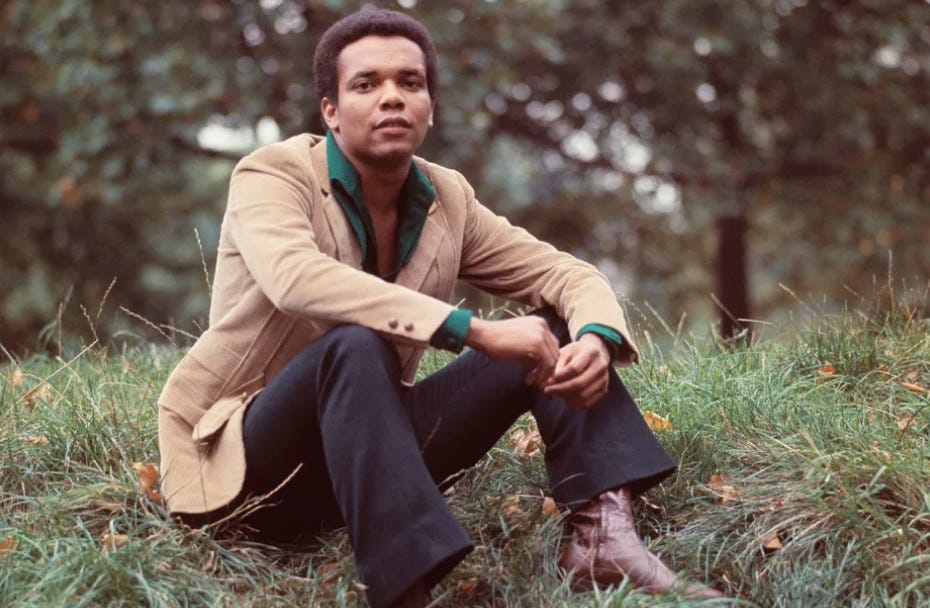
Picture from Michael Putland/Getty Images
Elegy for Johnny Nash
How does your voice
stir up the sunshine?
Why does your song
pour sugar on me?
The more I find out
the less I know.
Andy Jackson